What is Reverse Osmosis & Do You Really Need It?
What Is Reverse Osmosis and Do You Actually Need It?
Reverse osmosis sounds like something that belongs in a lab coat, not under your kitchen sink. But for many homeowners, it can be one of the most practical ways to improve drinking water quality. It is not magic, and it is not necessary for every single water problem. But when the concern is dissolved contaminants, certain metals, PFAS, nitrates, arsenic, fluoride, or “I just do not trust what is in this glass,” reverse osmosis deserves a serious look.
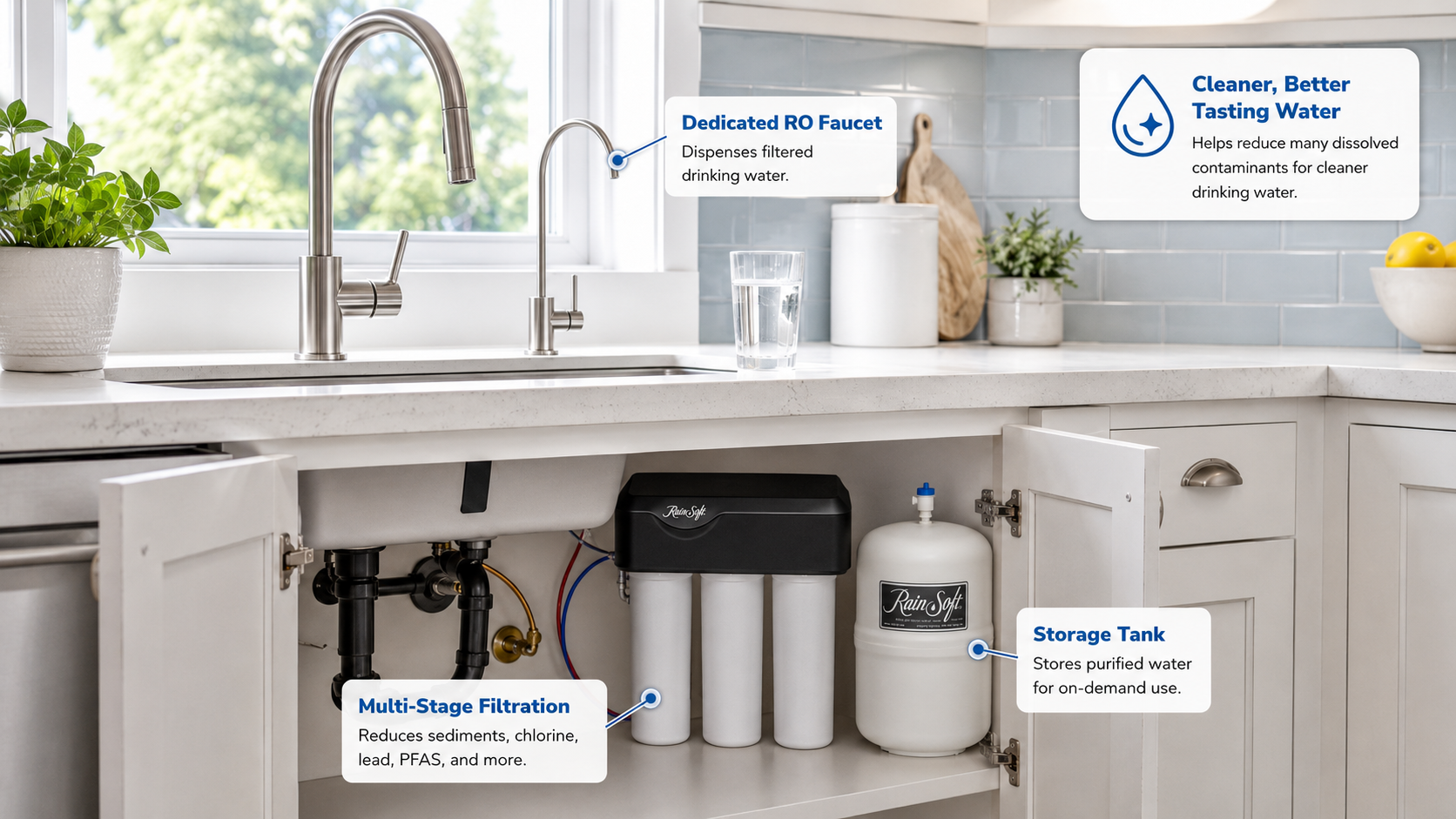
The important thing to understand is this: reverse osmosis, often shortened to RO, is usually a drinking water solution, not a whole-home cure-all. It is commonly installed at the point of use, such as under the kitchen sink, and is designed to produce cleaner drinking and cooking water. For showers, laundry, toilets, and appliances, a water softener or whole-house filtration system may be the better fit.
So do you actually need reverse osmosis? Maybe. The answer depends on what is in your water, where your water comes from, and what you want the system to solve.
How Reverse Osmosis Actually Works
According to the U.S. Environmental Protection Agency, a point-of-use reverse osmosis system is connected to a single fixture and uses pressure to force water through a semi-permeable membrane. The treated water is called permeate, while the rejected water is called concentrate or brine. In plain English, clean water gets pushed through the membrane, while many unwanted substances are separated and flushed away.
A good RO system is usually not just one filter. It is normally a multi-stage process. First, pre-filters help reduce sediment, chlorine, and other materials that could damage the membrane or affect taste. Then the RO membrane does the heavy lifting by reducing dissolved solids and many contaminants that basic carbon filters cannot handle. Finally, many systems use a post-filter to polish the taste before the water reaches your faucet.
Think of it like a tiny bouncer at the molecular nightclub. Water molecules get through. Many larger dissolved substances, metals, salts, and contaminants get shown the exit. Tiny velvet rope, big job.
What Reverse Osmosis Can Remove
Reverse osmosis is popular because it can reduce a wide range of contaminants. The EPA notes that point-of-use RO systems can potentially remove contaminants such as lead, VOCs, PFAS, arsenic, bacteria, and viruses. However, performance depends on the system design, certification, maintenance, and the specific contaminants in your water.
NSF, one of the major third-party certification organizations for water treatment products, lists certified reverse osmosis systems for several contaminant categories, including lead, arsenic, chlorine, chloramine, chromium, fluoride, nitrate/nitrite, PFOA/PFOS, and certain VOCs.
Common contaminants RO may help reduce include:
- Lead
- Arsenic
- Nitrates and nitrites
- Fluoride
- PFAS, including PFOA and PFOS
- Total dissolved solids
- Certain VOCs
- Some bacteria and viruses, depending on certification and system design
- Salts and dissolved minerals
- Unpleasant drinking water taste caused by dissolved substances
That said, RO should not be treated as a one-size-fits-all safety shield. If your water has a known bacterial issue, especially in a private well, you may need proper well disinfection, UV treatment, or another microbiological treatment strategy. RO can be part of the solution, but it should not be guessed into place. Water treatment should be based on testing, not vibes.
Why Reverse Osmosis Matters in Missouri and the Ozarks
In Southwest Missouri, South-Central Missouri, and Northwest Arkansas, water quality can vary widely. Some homes are on city water. Some are on private wells. Some have hard water. Some have iron staining. Some have odor issues. Some have agricultural runoff concerns. Some have older plumbing. Some have a mysterious glass of water that tastes like it has a backstory.
Missouri-specific water concerns are worth taking seriously. Missouri Department of Health and Senior Services notes that private drinking water can be affected by microorganisms, nitrates, heavy metals, arsenic, and fluoride. The department also notes that high nitrate levels are especially concerning for infants, and that heavy metals may occur naturally or be connected to mining history and plumbing materials.
Private wells are especially important to watch. MU Extension reports that Missouri has more than 400,000 private wells, accounting for more than 17 percent of the state’s water supply and serving more than 1.4 million Missourians. Unlike public water supplies, private wells are the homeowner’s responsibility. That means testing, maintenance, and treatment decisions fall on the person living in the home.
This is one reason reverse osmosis is such a strong conversation for local homeowners. It is not because every home automatically needs it. It is because many homeowners do not know what is actually in their drinking water until they test it.
Reverse Osmosis vs. Carbon Filters
A basic carbon filter and a reverse osmosis system are not the same thing. Carbon filtration is excellent for many taste and odor issues. It can help with chlorine, some organic chemicals, and general drinking water improvement. But carbon filters do not typically reduce dissolved solids the way RO does.
Reverse osmosis goes deeper by using the membrane process to reduce dissolved contaminants. That is why RO is often recommended when the concern is not just taste, but what is dissolved in the water.
Carbon filtration may be enough if your concern is:
- Chlorine taste
- Chlorine odor
- General taste improvement
- Some organic compounds
Reverse osmosis may be better if your concern is:
- PFAS
- Lead
- Nitrates
- Arsenic
- Fluoride
- Total dissolved solids
- Drinking water safety beyond taste and odor
Reverse Osmosis vs. a Water Softener
This is where homeowners get tangled in the plumbing spaghetti. A water softener and an RO system solve different problems.
A water softener is mainly used to handle hard water. It reduces hardness minerals like calcium and magnesium, which helps protect plumbing, fixtures, water heaters, dishwashers, washing machines, and other appliances. Soft water can also help with soap lather, laundry feel, dry skin complaints, and scale buildup.
Reverse osmosis is mainly used for drinking water. It reduces many dissolved contaminants and improves the quality of water you drink, cook with, and use for ice, coffee, tea, baby formula, and pet bowls.
In many homes, the best setup is not softener versus RO. It is softener plus RO. The softener protects the home. The RO protects the glass.
What Reverse Osmosis Does Not Solve
RO is powerful, but it is not the answer to every water complaint. If your shower glass is crusty, your water heater is scaling, your laundry feels stiff, and your faucets are collecting white buildup, your main issue is probably hard water. RO at the kitchen sink will not protect your whole home from scale.
RO also does not automatically fix pressure problems, water heater issues, orange staining from iron, sulfur odors throughout the house, or bacteria problems in a private well. Those issues may require whole-house filtration, softening, UV, oxidation, chlorination, well service, or another treatment approach.
That is why testing matters. Otherwise, you are throwing water-treatment darts in the dark, and nobody wants a plumbing carnival.
The Water Waste Factor
Reverse osmosis works by separating treated water from rejected water, so some water goes down the drain. That is normal. But the amount varies a lot by system.
The EPA notes that a typical point-of-use RO system can generate five gallons or more of reject water for every gallon of treated water produced, and some inefficient units can generate up to 10 gallons of reject water per gallon treated. However, WaterSense-labeled point-of-use RO systems must send 2.3 gallons or less down the drain for every gallon produced.
That matters because older or cheaper systems may be less efficient. Newer, properly designed systems can reduce waste significantly. This is one of those details that does not sound exciting until you realize it affects your water bill, your system performance, and your general level of “why is this thing running forever?”
Does Reverse Osmosis Remove Healthy Minerals?
Yes, reverse osmosis can reduce minerals like calcium and magnesium. This is one of the reasons some people say RO water is “too pure.” But for most people, drinking water is not the main source of dietary minerals. Food typically provides far more minerals than tap water.
Some homeowners prefer the clean, crisp taste of RO water. Others like a remineralization post-filter to add a little mineral content back for taste. This is mostly a preference issue unless a doctor has given you specific dietary guidance.
The bigger question is not “does RO remove minerals?” It is “what else is in my water that I do not want to drink?”
How Much Does Reverse Osmosis Cost?
Costs vary depending on the system type, number of stages, installation needs, water quality, and whether you are using a basic under-sink unit or a higher-end system. EPA’s PFAS filter guidance lists point-of-use RO systems in the general range of $150 to $1,000, not including maintenance.
Maintenance matters. Filter cartridges and the RO membrane need to be replaced according to the manufacturer’s instructions. If filters are ignored, the system can lose effectiveness, taste can decline, and the membrane may wear out sooner. The EPA specifically notes that filters are only effective when maintained according to manufacturer instructions.
For many families, RO becomes appealing when compared to bottled water. Bottled water adds up quickly, takes up space, creates plastic waste, and still may not solve the root issue in the home. A properly maintained RO system gives you treated water from your own faucet.
When You Probably Need Reverse Osmosis
Reverse osmosis is worth considering if your water test shows certain contaminants, or if you have a specific concern that basic filters may not address.
You may be a good candidate for RO if:
- You use a private well and have not tested recently
- Your water test shows nitrates, arsenic, lead, PFAS, fluoride, or elevated dissolved solids
- You are concerned about drinking water quality beyond taste and odor
- You rely heavily on bottled water
- You want better water for coffee, tea, ice, cooking, baby formula, or pets
- You have older plumbing and are concerned about lead or copper
- You want a dedicated drinking water system at the kitchen sink
When You May Not Need Reverse Osmosis
RO may not be necessary if your water concerns are better solved by other systems.
You may not need RO if:
- Your main issue is hard water scale throughout the house
- Your main complaint is chlorine taste, and a carbon filter is enough
- Your water issue is iron staining, sulfur odor, or sediment throughout the home
- You need whole-home protection for appliances and plumbing
- Your water already tests well and you simply want minor taste improvement
In those cases, a softener, whole-house carbon system, specialty filtration, or another solution may be the better first step.
The Best First Step: Test Your Water
The smartest water treatment plan starts with a water test. City water and well water have different concerns. A home in Springfield may have a different water profile than a home near Branson, Lake of the Ozarks, Joplin, Nixa, Ozark, Lebanon, or Northwest Arkansas. Even two neighboring homes can have different issues, especially when wells are involved.
Testing helps separate “this tastes weird” from “this has a measurable problem.” That is a big difference. Taste, smell, and appearance can tell you something is off, but they cannot tell you everything. Many contaminants have no obvious smell, color, or taste.
Once you know what is in the water, the treatment path gets much clearer. Maybe you need RO. Maybe you need a softener. Maybe you need whole-house carbon filtration. Maybe you need UV. Maybe you need a combination. Or maybe your water is mostly fine, and you just need a simpler solution.
Final Answer: Is Reverse Osmosis Worth It?
Reverse osmosis is worth it when your drinking water needs deeper treatment than a basic filter can provide. It is especially useful for homeowners concerned about PFAS, lead, nitrates, arsenic, fluoride, dissolved solids, or overall drinking water quality.
It may not be worth it if your only issue is hard water buildup, shower spots, laundry problems, or appliance scale. Those problems usually call for a water softener or whole-home treatment instead.
The best answer is not “everyone needs RO” or “no one needs RO.” The best answer is: test the water, understand the problem, then choose the right solution.
The only way to know is testing. Aquasani helps homeowners across Southwest Missouri, South-Central Missouri, and Northwest Arkansas understand what is actually in their water and what kind of system makes the most sense.
We’ll help guide you in the right direction for your water filtration needs, whether that means reverse osmosis, a water softener, whole-house filtration, UV treatment, or something simpler.
No pressure. Just answers.
Call 417-881-4000 or visit aquasani.net
Sources
- U.S. EPA WaterSense: Point-of-Use Reverse Osmosis Systems
- U.S. EPA: Identifying Drinking Water Filters Certified to Reduce PFAS
- NSF: Contaminant Reduction Claims Guide
- Missouri Department of Health & Senior Services: Private Drinking Water Contaminants
- University of Missouri Extension: Drinking Water Well Management