What a Dirty Office Water Cooler Actually Costs You
Most offices treat the water cooler like a fixture: fill it, forget it, replace the jug when it runs dry. That habit is more expensive than it looks, not in dollars at first, but in what is actually growing inside the unit between cleanings.
How dirty does an office water cooler actually get?
A peer-reviewed study of bottled water coolers found that 62 percent of cooler samples exceeded the accepted drinking water limit of 500 colony-forming units per milliliter, compared with just 3 percent of the tap water samples tested. The average bacterial count from the coolers was 38,864 CFU per milliliter, against 61 CFU per milliliter in the tap water that filled them.
That gap is the important part. The water going into these coolers started out clean. What comes out the spigot months later is not the same water, because the contamination is happening inside the cooler.
Why do coolers get dirtier than the water that fills them?
Researchers point to biofilm, a thin layer of bacteria that forms on the inside surfaces of the reservoir and spigot over time. The same study identified the high surface-to-volume ratio inside coolers, low or absent chlorine in standing water, and long stagnation periods between refills as the conditions that let biofilm take hold. Plastic components inside the unit give bacteria an easy surface to cling to.
The researchers also flagged specific organisms recovered from contaminated units, including Bacillus cereus and Mycobacterium conceptionense, both opportunistic pathogens that pose more risk to people with weaker immune systems, a relevant detail for any office serving the public or a mixed-age staff.
How often should an office water cooler actually be cleaned?
European food safety guidance for bottled watercoolers recommends full cleaning and disinfection at least every 13 weeks, roughly quarterly, for standard units. Coolers equipped with built-in ozonation or UV treatment can stretch that interval, but even those still need a hygienic maintenance check partway through. The guidance is explicit that this schedule exists to control biofilm before it affects water taste and safety, not as a suggestion.
Most offices never hit that schedule, because nobody owns the task. The jug gets swapped by whoever is closest to empty, and the inside of the unit goes untouched for a year or more.
Jug cooler or bottleless: what actually changes the risk?
| Factor | Bottled jug cooler | Bottleless filtered cooler |
|---|---|---|
| Standing water time | Days to weeks per jug, longer in low-traffic offices | Continuously filtered from the building line, minimal stagnation |
| Exposed spigot and reservoir | Open reservoir, handled jugs, frequent contact points | Sealed line from supply to tap |
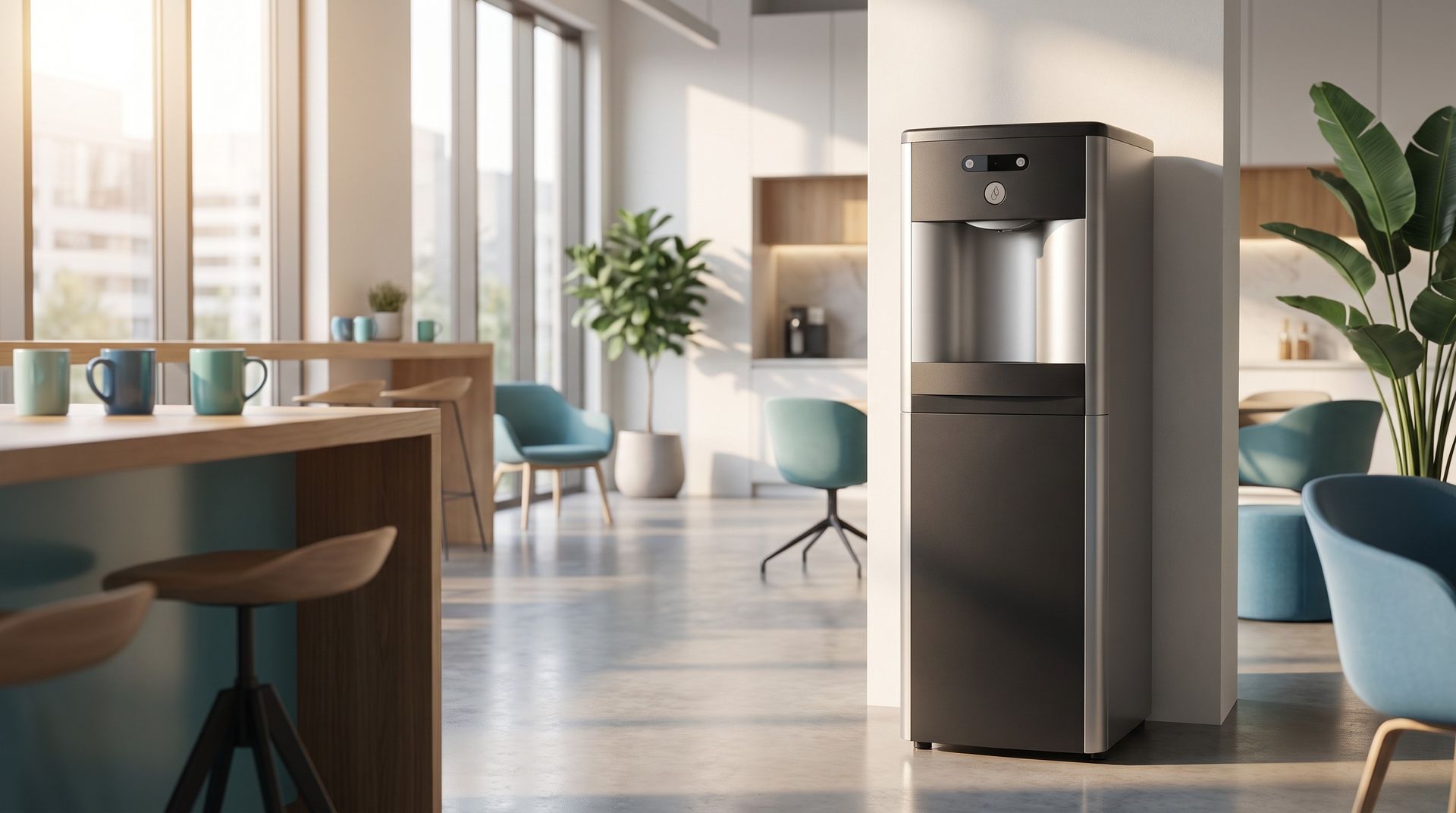
| Who maintains cleaning | Usually nobody, unless specifically scheduled | Typically included in a service and filter-change plan |
| Heavy jug handling | Yes, staff lift and change 5-gallon jugs | No jug changes required |
Does bad water access actually hurt productivity?
A study published in the British Journal of Nutrition found that mild dehydration, about 1.6 percent of body mass lost in men with no other symptoms, produced measurable effects at rest: more errors on visual vigilance tasks, slower response times on working memory tasks, and higher reported fatigue and tension. These were described as limited but detectable changes, smaller than the effects seen at more severe dehydration levels, but present well before anyone would describe themselves as thirsty.
A cooler nobody trusts, because it looks or tastes off, is a cooler people quietly stop using. That is a hydration problem hiding behind a maintenance problem, and it shows up in afternoon focus before anyone connects the two. Multiply that across a full staff over a full week, and a neglected cooler is doing quiet damage well before anyone files a complaint about it.
What should a business actually do about it?
- ✓ Put cooler cleaning on a recurring calendar, at least quarterly, instead of leaving it to whoever notices.
- ✓ Assign ownership of the task to a specific role, not "whoever is around."
- ✓ Watch for warning signs between cleanings: slow flow, odd taste, visible buildup around the spigot.
- ✓ Consider a bottleless system if cleaning keeps slipping, since it removes the standing-water design that causes the problem.
If your office has multiple locations, this gets harder to track consistently. Our post on bottleless water coolers covers how that system works and why more businesses are moving off jugs entirely, and The Water Bottle Trap looks at the related cost and plastic problem with single-use bottles in the break room.
When is the last time anyone actually looked inside your break room cooler, not just swapped the jug? If the honest answer is "I don't know," that is worth more than a quick wipe-down.
Not sure what's in your office water?
Schedule a no-cost water analysis for your business and find out what a cleaner setup would look like. No pressure, just answers, for offices across Missouri and Arkansas.
Warmly, the Aquasani team
Frequently asked questions
+ Is tap water cleaner than water cooler water?
In the study referenced above, yes. Only 3 percent of tap water samples exceeded safe bacteria limits, compared with 62 percent of cooler samples, because contamination builds up inside the cooler itself over time.
+ How often should a water cooler be cleaned?
European food safety guidance for watercoolers recommends full cleaning and disinfection about every 13 weeks, roughly quarterly, for standard units. Units with built-in ozonation or UV treatment can go longer between full cleanings.
+ Does a bottleless cooler solve the bacteria problem?
It removes the main cause, standing water sitting in a reservoir for days or weeks. Bottleless systems draw continuously from the building's water line through a filter, which cuts the stagnation that lets biofilm form in the first place.
+ Can a dirty cooler actually make someone sick?
Researchers have recovered opportunistic pathogens from contaminated coolers, which pose more risk to people with weaker immune systems. For a healthy adult the risk is lower, but it is not zero, especially in an office that nobody has cleaned in months.
+ Does poor hydration really affect work performance?
A British Journal of Nutrition study found that even mild dehydration, about 1.6 percent of body mass, produced more errors on attention tasks and slower response times on memory tasks in men at rest, along with increased fatigue.